← Back to Home

AI-Powered Reconciliation Engine

FintechERPAI UX
Industry
Finance, P2P
Year
2025-2026
Role
UX Designer
Timeline
8 months
Team
1 PM, 4 Engineers

Reduced manual reconciliation review time across 3 document types

Overview

In most finance departments, "reconciling" is just a fancy word for a tedious, manual game of "spot the difference." Even with ERP systems like NetSuite, teams spend hours every day cross-referencing purchase orders, bills, and bank statements.

When the numbers don't match exactly, automation usually fails. This forces a human to step in and manually hunt through different platforms to figure out why. It's a slow, exhausting process that leads to burnout and easy-to-miss mistakes.

UX Challenge

Designing a financial reconciliation engine means balancing messy data with the need for accuracy. Here's what mattered most:

AI Trust Gap

Auditors are naturally skeptical of AI. Without visible reasoning and confidence levels, they revert to manual checking.

Cognitive Load

Data lives across disconnected platforms and formats. Consolidating it into one view removes the mental tax of jumping between systems.

Cost of Error

In finance, "close enough" isn't an option. A small UI error can turn into a real compliance or financial problem.

The Process

01

Ideation and alignment

Led cross-functional workshops with engineers and PMs, using Crazy 8s to align technical constraints with user needs.

02

Data mapping & edge cases

Mapped how purchase orders, bills, and bank statements interact, identifying every edge case the system needed to handle.

Raw DataRaw DataRaw DataStandardized DataAnalyzed by Date, Amount, VendorHigh ConfidenceLow ConfidencePre-Aligned DataFlagged ItemsRequires ReviewValidatedPush UpdatesBank DataERP DataDocumentsNormalizationUnified Data StructureAI MatchingProbabilistic AnalysisCategorizationExact MatchAuto-ReconciledRevision QueueReview QueueAuditor DashboardHuman InterventionManual ValidationFinal ExportReconciled RecordsERP SystemSynced Data
03

AI interaction and patterns

Applied AI UX patterns focused on trust and transparency, moving away from black-box automation toward visible reasoning.

04
High-fidelity designs

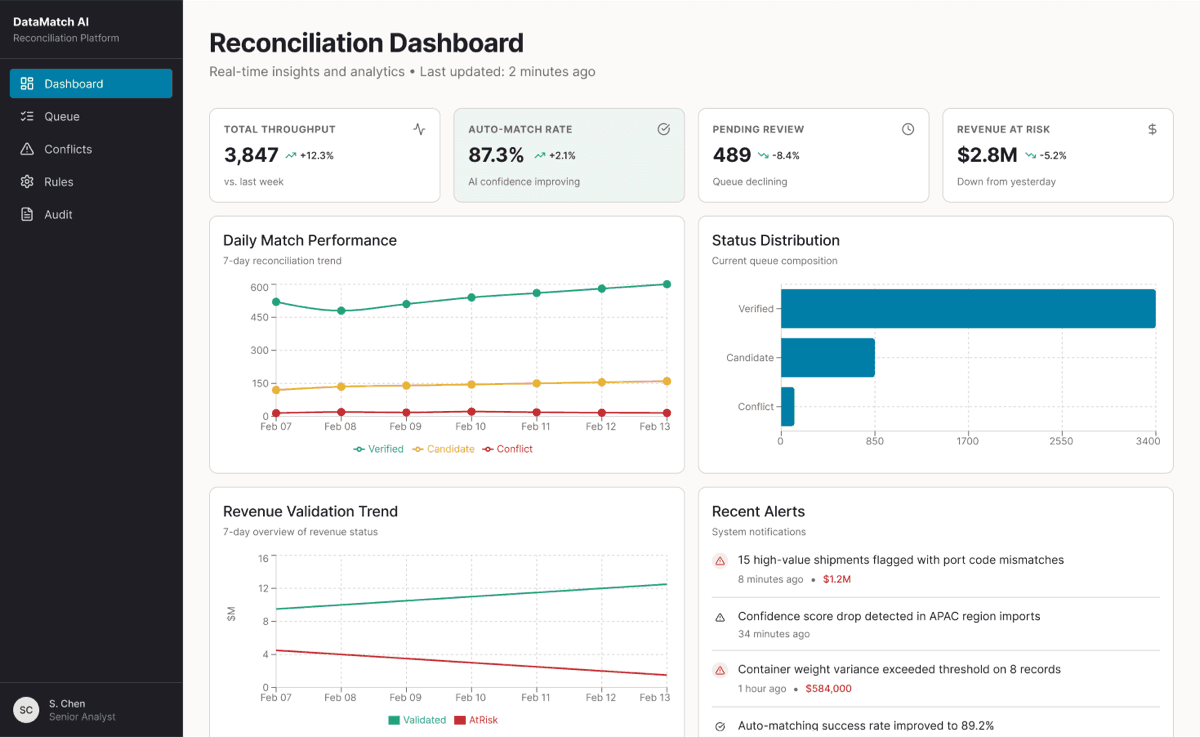
Built a dense but scannable dashboard that pulled fragmented data into one view, so auditors don't have to work hard to read it.

Reconciliation dashboard showing throughput, auto-match rate, and daily match performance charts
05

Fast validation

Used Figma Make to prototype and test the flow in real time, so the team could agree on a direction faster.
Impact

This project is currently in active development. The reconciliation engine was designed to eliminate manual cross-referencing between purchase orders, vendor bills, and bank statements.

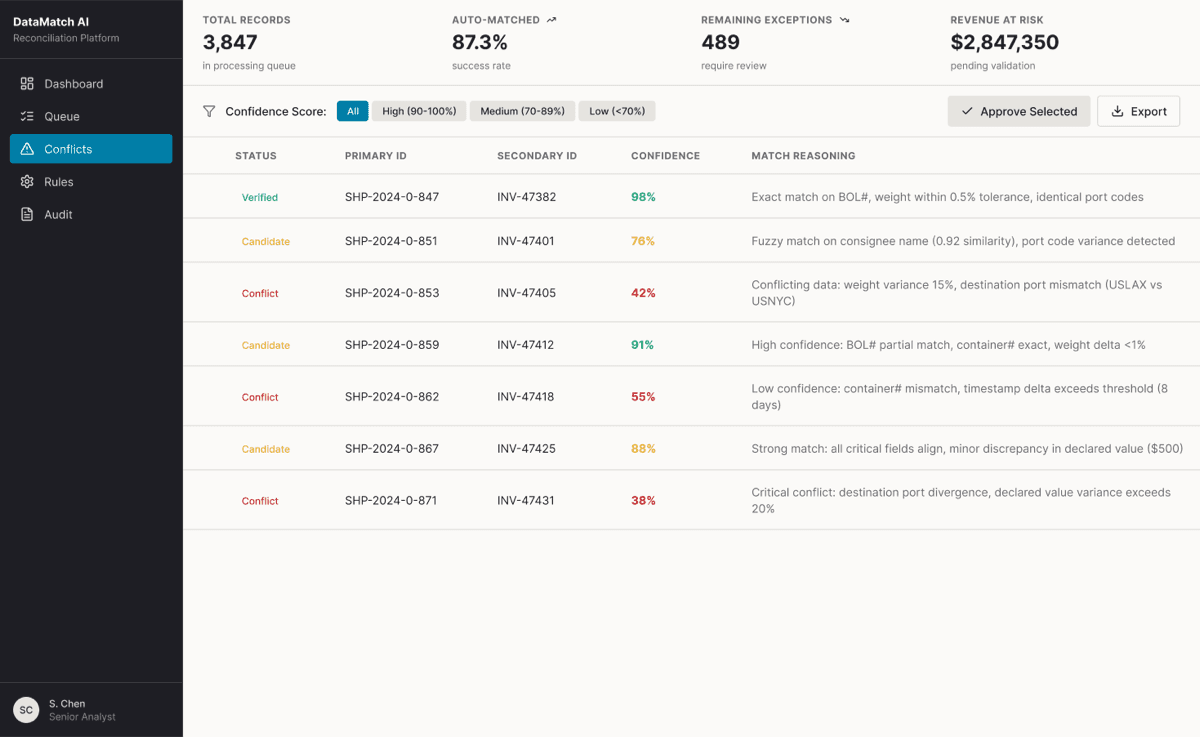
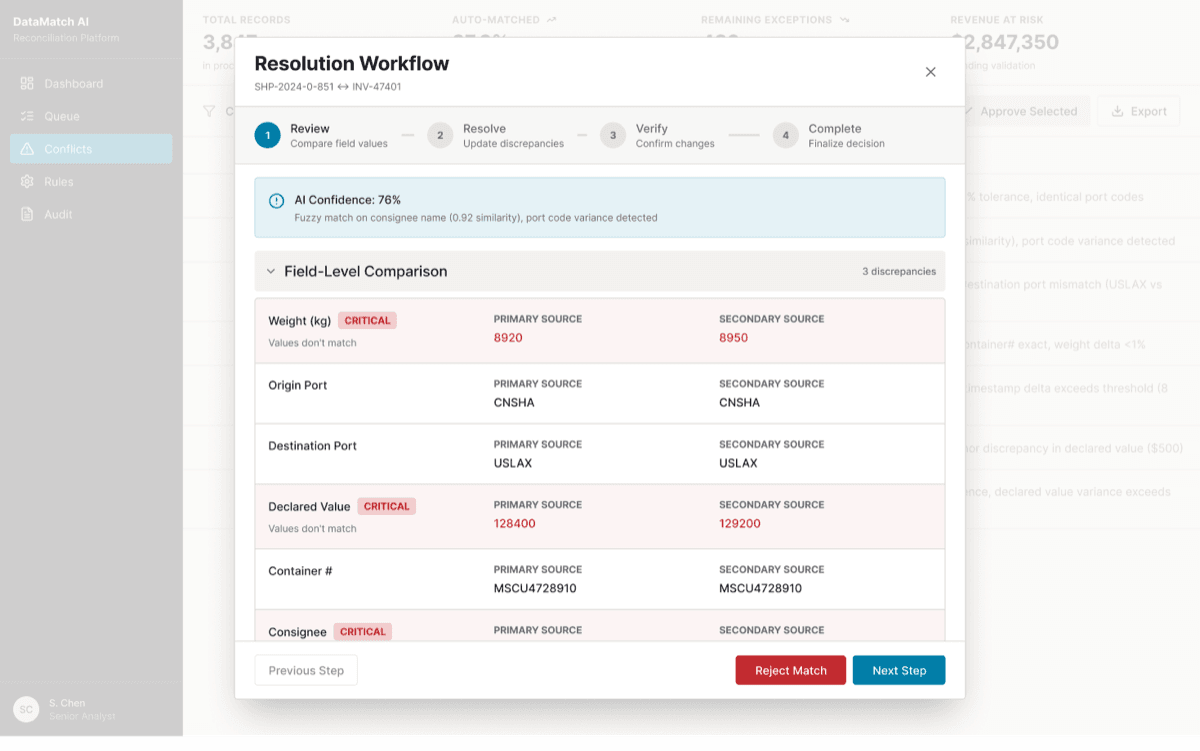
It handles ambiguous matches that used to send someone hunting across multiple platforms. Confidence scores and reasoning show up right in the flow, so auditors can decide without switching tabs.

The core idea, AI suggestions with visible logic and a required human sign-off on anything uncertain, is now the standard we're carrying forward for AI-assisted finance workflows in the product.

Conflicts queue with confidence scores and match reasoning for each flagged record
Resolution workflow modal comparing field-level discrepancies between primary and secondary sources

Key Takeaways

Confidence over Automation

Lead with confidence scores so auditors can skip the obvious matches and focus only on high-risk exceptions.

Traceability by Default

Every match includes a reasoning path linking specific data points. No result ships without a visible why.

Human-in-the-Loop Authority

Low-confidence matches require manual verification. Speed never overrides the auditor's final authority.

Unified Data Mapping

Mapping fragmented formats into one flow removes the need to jump between platforms to verify a transaction.